For years, many businesses have thought about SEO in fairly simple terms: where do we rank on Google?
That question still matters. Search rankings remain important, and Google continues to be one of the most valuable ways for potential customers to find a business. But the way people search, compare and choose suppliers has changed significantly.
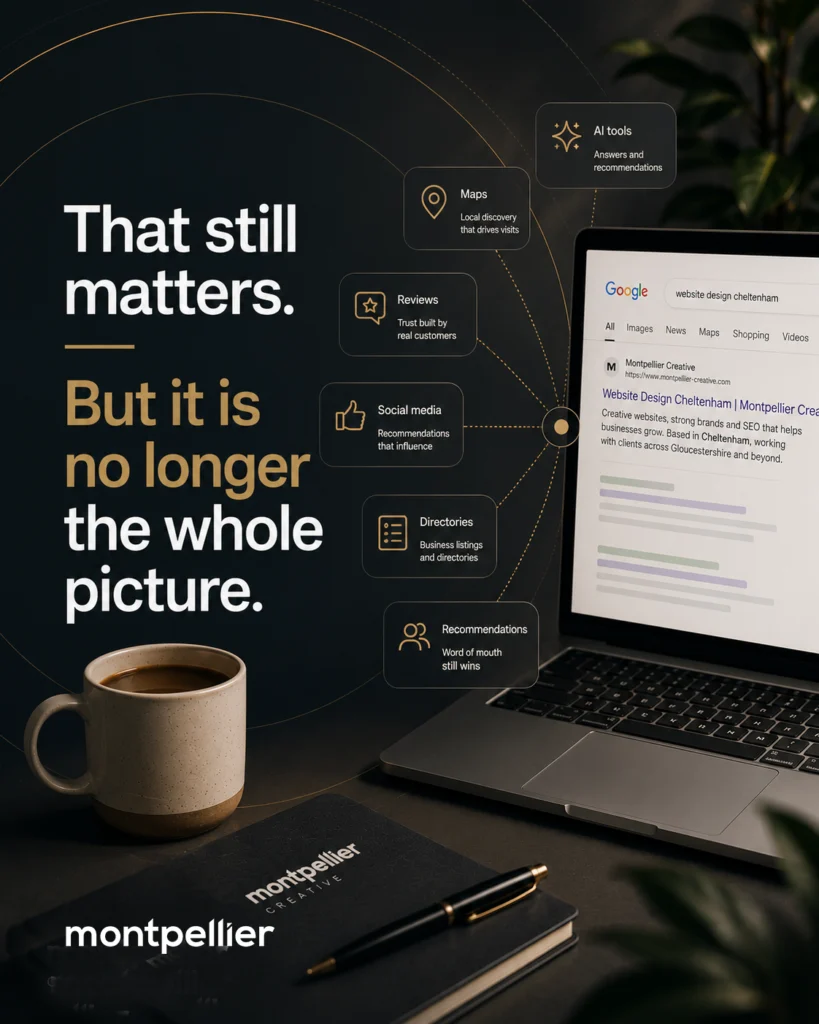
Today, customers rarely rely on one source of information. They may begin with a Google search, check reviews, look at your social media, ask an AI tool for recommendations, compare your website with competitors, look at maps, read directory listings or ask a colleague for a trusted name.
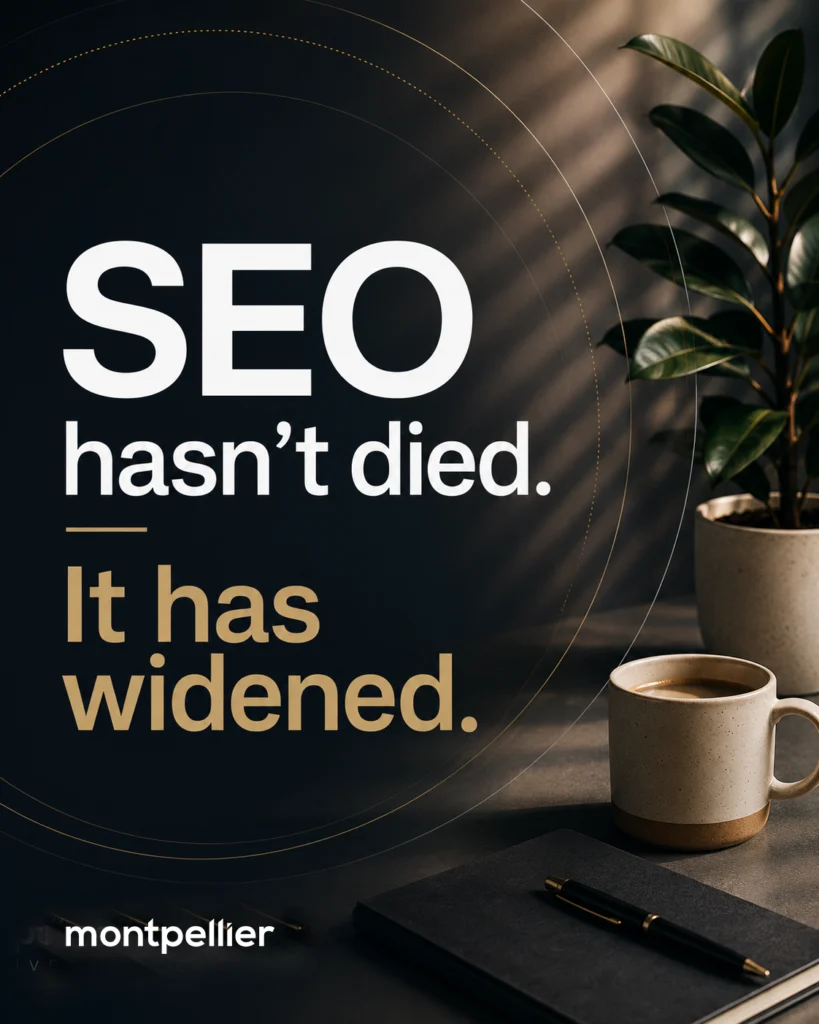
In other words, SEO has not died. It has widened.
Search visibility is no longer just about appearing in a list of blue links. It is about whether your business is clear, credible and easy to understand across the many places where people now discover information. This is where SEO, GEO, branding and website design increasingly overlap.
For businesses, this creates both a challenge and an opportunity. The challenge is that visibility has become more complex. The opportunity is that businesses with clear messaging, useful content, strong websites and credible brands are well placed to benefit.
Traditional SEO still matters
It would be a mistake to assume that because search is changing, traditional SEO no longer matters. The fundamentals are still essential.
Your website still needs to be technically sound. It needs to be crawlable, fast, mobile-friendly and easy for search engines to understand. Your pages still need clear titles, useful headings, relevant content and a logical structure. You still need to understand what your potential customers are searching for and create content that answers those questions.
Good SEO has always been about more than keywords. At its best, SEO connects what people are looking for with the information, services or expertise a business can provide.
That principle has not changed.
What has changed is the number of places where that information might be interpreted, summarised or used. A well-structured service page may help you rank in Google. It may also help an AI search tool understand what your business does. A useful article may answer a customer’s question directly. It may also strengthen your overall authority on a subject.
So the fundamentals remain important. But they now sit within a wider visibility landscape.
Search behaviour has changed
The way people search has become more conversational and more fragmented.
A few years ago, someone might have searched for “SEO agency Cheltenham” or “website designer Gloucestershire”. They might still do that. But they might also ask a much fuller question, such as:
“What should I look for in a website design agency?”
“How can I improve my business visibility online?”
“Who can help with SEO and branding for a local business?”
“What is GEO and does my business need it?”
These are not just keyword searches. They are questions. They suggest that the user wants explanation, comparison and guidance.
At the same time, customers are not only searching through Google. They are increasingly using AI tools, social platforms, maps, review sites, online directories and recommendation-based discovery. Someone might first notice a business on Instagram, check its website, read its Google reviews, ask ChatGPT for general advice, then return to Google to search for the company by name.
That journey is not linear. It moves across platforms.
This is why visibility can no longer be treated as a single-channel exercise. A business that ranks well but has weak messaging, poor reviews, inconsistent information or an outdated website may still lose the enquiry. Likewise, a business with a strong brand but limited useful content may struggle to be discovered in the first place.
The most effective digital presence is joined up.
What is GEO?
GEO stands for Generative Engine Optimisation. It is a relatively new term, but the idea behind it is straightforward.
Where SEO is concerned with improving visibility in search engines, GEO is concerned with making your business, content and expertise easier for generative AI systems and answer engines to understand, summarise and recommend.
This does not mean abandoning SEO. It does not mean filling your website with robotic content or trying to trick AI tools. In fact, the opposite is true.
GEO rewards clarity.
If your website clearly explains what you do, who you help, where you operate, what problems you solve and why your business is credible, it becomes easier for both people and search systems to understand. If your content answers real questions in a useful and specific way, it becomes more valuable. If your business information is consistent across your website and wider digital presence, it becomes more trustworthy.
The aim is not simply to “rank”. The aim is to be understood.
That is an important shift. In the past, many businesses asked: “How do we get higher in Google?” Increasingly, the better question is: “Are we visible, credible and easy to recommend?”
Why brand clarity is now part of search strategy
Branding and SEO have often been treated as separate disciplines. Branding was seen as visual identity, tone of voice and positioning. SEO was seen as keywords, rankings and traffic.
That separation no longer reflects how customers make decisions.
A potential customer does not experience your brand and your SEO separately. They experience your business as a whole. They see your search result, your page title, your website, your imagery, your content, your reviews, your social posts and your calls to action. Each element either builds confidence or weakens it.
A clear brand makes your SEO stronger because it helps define the language your business should use. It clarifies your audience, your value proposition and your difference. It makes your content more focused and your website easier to navigate.
If a business cannot explain itself clearly, its website content usually becomes vague. And vague content is unlikely to perform well, either with people or search engines.
Strong branding answers important questions:
- Who are you for?
- What problem do you solve?
- Why should someone trust you?
- What makes your approach different?
- What should someone do next?
These are also search questions. They influence how pages are written, how services are described and how potential customers understand your relevance.
In this sense, brand clarity is not just a design concern. It is a visibility concern.
Your website is still the source of truth
With so much attention now on AI tools, social media and third-party platforms, it can be tempting to think the website has become less important. In reality, the opposite is true.
Your website remains the source of truth for your business.
It is the place where you control the message. It is where you explain your services in depth, demonstrate your expertise, present your case studies, answer common questions and guide visitors towards making contact.
It is also the place search engines and AI systems are most likely to look for structured, reliable information about your business.
A social media post may attract attention. A review may build trust. A directory listing may support local visibility. But your website should bring everything together.
For many businesses, the website needs to work harder than it did five or ten years ago. It cannot simply be a digital brochure. It needs to act as a visibility platform, credibility builder and conversion tool.
That means service pages should contain enough substance to be genuinely useful. Articles should answer questions that potential customers actually ask. Case studies should show evidence of experience. Calls to action should be clear. Navigation should be simple. The site should work well on mobile and load quickly.
A beautiful website that does not explain, persuade or convert is unfinished.
What businesses should do now
The businesses that will benefit from the next phase of search are not necessarily those that publish the most content. They are the ones that are clearest, most useful and most credible.
There are several practical steps businesses can take.
Start by reviewing your service pages. Do they clearly explain what you offer, who it is for and why it matters? Or are they too thin, too generic or too focused on internal language?
Look at your website through the eyes of a potential customer. Can they quickly understand what you do? Can they see evidence that you are credible? Is it obvious how to take the next step?
Review your content. Are you answering real questions, or simply publishing updates for the sake of activity? Useful articles, FAQs, guides and opinion pieces can all support SEO and GEO when they are written with genuine purpose.
Check your brand consistency. Does your website match your social presence? Do your visuals, tone of voice and messaging feel coherent? Are your business details consistent across platforms?
Look at your local visibility. For many businesses, Google Business Profile, reviews, maps and local content remain hugely important. GEO does not replace local SEO. It adds another layer to it.
Finally, think about authority. Do you have case studies, testimonials, sector expertise, team profiles, accreditations or examples of work that demonstrate why someone should trust you? Visibility without trust rarely converts.
SEO, GEO, branding and websites now need to work together
The next phase of search is not about chasing every new trend. It is about building a stronger, clearer digital presence.
SEO still matters. GEO is becoming more important. Brand clarity has a direct impact on how your business is understood. Your website remains central to the whole system.
For businesses, the opportunity is to stop treating these areas as separate projects. Your SEO strategy should inform your website content. Your brand positioning should shape your messaging. Your website should support both discovery and conversion. Your social content should reinforce your expertise. Your wider online presence should build confidence.
Search has widened, but the underlying goal remains familiar.
- Be useful.
- Be clear.
- Be credible.
- Be consistent.
The businesses that do this well will be easier to find, easier to trust and easier to recommend.
SEO has not died. It has become part of a much wider visibility challenge — and for businesses willing to adapt, that is a significant opportunity.
FAQ: SEO, GEO and the Changing Search Landscape
Is SEO still important?
Yes. SEO is still important because people continue to use Google and other search engines to find businesses, services and information. What has changed is that SEO now sits within a wider visibility landscape. Businesses also need to consider AI search, local search, reviews, social media, directories and brand credibility.
What does GEO mean in digital marketing?
GEO stands for Generative Engine Optimisation. It refers to the process of making your business, website and content easier for AI-powered search tools and answer engines to understand, summarise and recommend. GEO does not replace SEO. It builds on the same foundations of clarity, usefulness, authority and trust.
Has AI search replaced traditional SEO?
No. AI search has not replaced traditional SEO, but it has changed how businesses should think about visibility. Search engines, AI tools and potential customers all rely on clear, useful and credible information. A technically sound website, well-structured content and strong brand messaging remain essential.
How is GEO different from SEO?
SEO focuses on improving visibility in search engine results, while GEO focuses on helping generative AI systems understand and potentially recommend your business or content. SEO often considers rankings, search intent, keywords, technical performance and backlinks. GEO places additional emphasis on clarity, authority, structured information, useful answers and consistent brand signals.
Why does brand clarity matter for SEO and GEO?
Brand clarity matters because search engines, AI tools and customers all need to understand what your business does, who it helps and why it should be trusted. If your messaging is vague, your content is likely to be vague too. Clear positioning makes your website easier to understand, easier to rank and easier to recommend.
What should businesses do to prepare for AI search?
Businesses should focus on creating clear, useful and trustworthy content. That means improving service pages, answering real customer questions, adding FAQs, publishing helpful articles, using case studies, keeping business information consistent and making sure the website is fast, mobile-friendly and easy to navigate.
Is my website still important if people are using AI tools?
Yes. Your website is still one of your most important digital assets. It acts as the source of truth for your business. Search engines, AI tools and potential customers can all use your website to understand your services, expertise, location, values and credibility.
What kind of content helps with SEO and GEO?
Content that answers real questions is especially useful. This can include service pages, guides, FAQs, case studies, blog articles, comparison content, opinion pieces and practical advice. The best content is specific, well-structured and written for real customers rather than simply written to include keywords.
Can a small business benefit from GEO?
Yes. Small businesses can benefit from GEO by making their expertise, location, services and credibility clearer online. Local businesses often have valuable real-world experience, customer relationships and niche knowledge. When this is reflected clearly on their website and wider digital presence, it can support both traditional SEO and AI-era discovery.
What is the main takeaway for businesses?
The main takeaway is that visibility now means more than ranking on Google. Businesses need to be clear, credible and consistent across their website, content, brand, reviews, social media and wider digital presence. SEO has not died. It has widened.