Search is changing again. For more than two decades, businesses have competed for visibility on search engine results pages: blue links, featured snippets, map packs, shopping results and paid ads. The objective was relatively clear: rank well, earn the click, and convert the visitor.
But the rise of AI-powered search has changed the shape of that journey. Increasingly, people are not just typing keywords into Google and scanning a list of results. They are asking questions in tools such as Claude, ChatGPT, Gemini, Perplexity, Copilot and Google’s AI-powered search features. Instead of presenting a simple list of links, these systems generate answers, summaries, comparisons and recommendations.
That shift has created a new discipline: AI Search Optimisation, also known as GEO – Generative Engine Optimisation.
For businesses, the challenge is no longer simply “How do we rank?” It is also “How do we become one of the sources AI systems trust, understand, cite and recommend?”
What is AI Search Optimisation?
AI Search Optimisation is the process of improving your website, content and wider digital footprint so that your brand is more likely to appear in AI-generated answers.
Traditional SEO focuses on improving visibility in search engines. GEO builds on those foundations but adapts them for AI-driven discovery. It considers how generative systems interpret content, identify trustworthy sources, summarise expertise and select references when answering user questions.
Importantly, GEO does not replace SEO. Google’s own guidance for AI features states that the same core SEO best practices remain relevant for visibility in AI experiences such as AI Overviews and AI Mode. In other words, crawlability, useful content, page experience, structured information and authority still matter.
The difference is that AI search often compresses the research journey. A potential customer might ask:
“What is the best web design agency in Cheltenham for a B2B technology company?”
“Which agency can help with brand strategy and AI search visibility?”
“How do I optimise my company website for ChatGPT and Google AI Overviews?”
In each case, the user may not begin by visiting ten websites. They may expect the AI tool to summarise options, explain the landscape and point them towards credible providers. If your brand is absent from that answer, you may be invisible at the very moment the customer is forming their shortlist.
Why GEO matters now
AI search is not a future trend waiting politely in the distance. It is already changing how people discover information, suppliers, services and products.
ChatGPT search, for example, can enrich answers with web content and may show citations and source links that users can open. Microsoft’s Bing Webmaster Guidelines now explicitly discuss generative engine optimisation, describing GEO as a focus on content eligibility for grounding and reference in AI responses. Microsoft has also introduced AI Performance insights in Bing Webmaster Tools, giving site owners visibility into how their content is cited in Copilot, Bing AI summaries and selected partner integrations.
That is a significant signal. If platforms are beginning to measure AI citations, brands need to start managing AI visibility as part of their search strategy.
For many organisations, this is an opportunity. AI search is still relatively new, which means competitors may not yet have built a clear strategy. The brands that act early can establish authority before the space becomes crowded.
SEO vs GEO: what is the difference?
SEO and GEO are closely related, but they are not identical.
SEO is primarily concerned with discoverability in search results. It asks whether a page can be crawled, indexed, ranked and clicked. GEO goes further and asks whether a brand can be understood, trusted, summarised and cited by generative systems.
A traditional SEO strategy might focus on:
- keyword rankings
- metadata
- backlinks
- technical site health
- content relevance
- internal linking
- click-through rates
- conversions from organic search
A GEO strategy adds questions such as:
- Does the content answer natural-language questions clearly?
- Is the brand associated with a specific area of expertise?
- Are claims supported by evidence, examples and third-party validation?
- Can AI systems easily understand who the business serves and what it does?
- Is the content structured in a way that can be extracted, summarised and cited?
- Does the brand appear consistently across the wider web?
- Are service pages, case studies and thought leadership aligned around the same authority signals?
In short, SEO helps you appear in search. GEO helps you become part of the answer.
How AI search engines choose sources
The precise workings of AI search systems vary by platform and are not fully public. However, the direction of travel is clear. Generative search systems need reliable information to ground their answers. They look for content that is accessible, relevant, authoritative and useful.
That means businesses need to think beyond thin service pages and generic blog posts. AI systems are more likely to reference content that provides clear explanations, original insight, structured detail and evidence of expertise.
For example, a generic page titled “SEO Services” may struggle to stand out. A better GEO asset might be a detailed guide answering a specific buyer question, such as:
“How can B2B companies optimise their websites for AI search?”
“What is the difference between SEO, AEO and GEO?”
“How should professional services firms prepare for Google AI Overviews?”
“What makes a website more likely to be cited by ChatGPT or Perplexity?”
These kinds of pages do two useful things. They target real user questions, and they create content that can be summarised by AI tools.
The foundations of a GEO strategy
A strong GEO strategy should begin with the same foundations as good SEO. There is no shortcut around technical quality. If your site cannot be crawled or understood, AI visibility will be limited.
The essential foundations include:
Clear site structure
Your website should make it obvious what you do, who you help and where you operate. Service pages should be distinct, well-organised and internally linked.
Technically accessible content
Important content should be available in indexable HTML, not locked away in images, scripts, PDFs or interactive elements that search systems may struggle to parse.
Strong page titles and headings
AI systems need to understand the topic of each page quickly. Descriptive titles, logical headings and clear introductions all help.
Useful, expert-led content
AI search rewards clarity. Pages should answer real questions in depth, using practical examples rather than vague marketing language.
Schema and structured data
Structured data can help search engines understand entities, services, organisations, FAQs, articles and local business information.
Consistent entity signals
Your brand name, location, services, authorship, social profiles and third-party mentions should be consistent across the web.
Authority and trust
Backlinks, citations, case studies, media coverage, reviews and client examples all help reinforce credibility.
Content that works well for AI search
GEO-friendly content tends to be specific, structured and helpful. It should be written for people first, but organised in a way that machines can interpret.
Strong formats include:
Question-led articles
These answer the questions buyers are likely to ask AI tools. For example: “How do I choose a web design agency?” or “What should be included in a brand strategy project?”
Comparison pages
AI tools often respond to comparative prompts. Content that explains differences between services, approaches or technologies can perform well. For example: “SEO vs GEO” or “Brand refresh vs full rebrand.”
Definition pages
Clear definitions are useful for AI-generated summaries. A page that explains “What is generative engine optimisation?” may become a useful source.
Industry-specific guides
Generic content is often less compelling than sector-specific guidance. A page about SEO for technology companies, professional services, healthcare organisations or manufacturers may be more valuable than a broad SEO overview.
Case studies
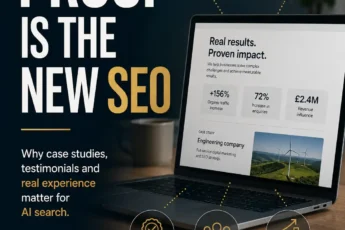
Original evidence is powerful. AI tools need credible examples, and case studies provide proof that a business has delivered results.
Thought leadership
Expert commentary, trend analysis and practical frameworks can help position a brand as an authority rather than just another supplier.
The role of PR in GEO
One of the most important aspects of GEO is that your website is only part of the picture.
AI systems do not judge your authority solely by what you say about yourself. They also draw on the wider web. That includes media coverage, industry articles, third-party mentions, directories, reviews, interviews, podcasts, LinkedIn content and other credible references.
This is where PR becomes increasingly valuable. Digital PR has long supported SEO by earning backlinks and brand mentions. In an AI search environment, it may become even more important because brand authority is distributed.
A company that is mentioned in respected trade publications, quoted in expert articles, listed in relevant directories and associated with a clear area of expertise gives AI systems more confidence.
For Montpellier Creative, this is a particularly strong opportunity. GEO sits at the intersection of SEO, content, PR, brand strategy and digital reputation. It is not just a technical exercise. It is a communications challenge.
Local GEO: being visible for location-based AI searches
Local search is also changing. Users may increasingly ask AI tools for recommendations such as:
“Who are the best web design agencies in Cheltenham?”
“Which branding agencies in Gloucestershire work with B2B companies?”
“Find a creative agency near me that can help with SEO and website design.”
To compete for these searches, businesses need strong local signals. That includes a well-optimised Google Business Profile, consistent directory listings, location pages, local case studies, client references, reviews and content that connects services to place.
For a creative agency, this might mean developing pages around:
- web design Cheltenham
- branding agency Cheltenham
- SEO agency Cheltenham
- creative agency Gloucestershire
- website design for Cheltenham businesses
The key is to make local relevance natural and useful. A weak local page simply repeats “Cheltenham” too often. A strong local page explains the agency’s work, experience, clients, services and understanding of the regional business landscape.
Measuring AI search visibility
One of the challenges with GEO is measurement. Traditional SEO tools are built around rankings, search volume and traffic. AI search visibility is more complex because results can vary depending on the prompt, user context, platform and live web data.
However, measurement is improving. Bing’s AI Performance reporting is one sign that citation visibility is becoming more measurable. Businesses can also manually test important prompts across platforms, monitor referral traffic from AI tools, track brand mentions, analyse server logs and review whether key content is being cited.
Useful metrics may include:
- citations in AI-generated answers
- mentions in ChatGPT, Perplexity, Gemini, Copilot and Google AI features
- referral traffic from AI platforms
- visibility for priority prompts
- growth in branded search
- rankings for question-led content
- backlinks and third-party mentions
- assisted conversions from organic and referral sources
GEO measurement will not be as simple as checking a keyword ranking, but it can still be managed with a structured approach.
Common GEO mistakes
The biggest mistake is treating GEO as a trick. Some businesses will look for shortcuts: hidden text, mass-produced AI content, keyword stuffing or attempts to manipulate generative systems. That is unlikely to build lasting visibility and may create risk.
A better approach is to focus on clarity, authority and usefulness.
Another mistake is creating lots of shallow content around AI search without adding any original value. AI systems already have access to thousands of generic articles. To stand out, content needs a point of view, practical guidance and evidence.
Businesses should also avoid separating GEO from brand strategy. AI tools need to understand what a company is known for. If your messaging is inconsistent, your services are unclear or your authority is scattered across unrelated topics, you make it harder for AI systems to categorise and recommend you.
How to get started with GEO
A practical starting point is to run an AI search visibility audit.
First, identify the questions your customers are likely to ask. These should include commercial, informational and comparison prompts. For example:
“Best agency for AI search optimisation in Cheltenham.”
“How can a B2B company improve visibility in ChatGPT?”
“What is GEO and how does it differ from SEO?”
“Which agency can help with brand, web design and SEO?”
Next, test those prompts across AI search platforms and record which brands, sources and pages appear. Look for patterns. Are competitors being cited? Are directories appearing? Are industry publications shaping the answer? Are your own pages absent?
Then review your content. Do you have pages that directly answer those questions? Are they detailed enough? Are they credible? Are they connected to your services? Are they supported by case studies, expert commentary and external authority?
Finally, build a content and authority plan. This should include technical SEO fixes, new service pages, thought leadership, FAQs, case studies, digital PR and local optimisation.
The future of search is answer-led
AI search does not mean websites are dead. It means websites need to work harder. They must be clear enough for people, structured enough for search engines and authoritative enough for AI systems to trust.
The winners will be the brands that understand the shift early. They will not abandon SEO. They will strengthen it, modernise it and connect it to PR, content strategy, brand positioning and digital authority.
GEO is not about chasing an algorithm. It is about becoming the kind of source that deserves to be referenced.
For businesses that depend on visibility, reputation and expertise, AI Search Optimisation is quickly becoming an essential part of digital strategy. Whether the customer is using Google, ChatGPT, Perplexity, Gemini or Copilot, the goal is the same: to ensure your brand is present, credible and compelling when the answer is being formed.
That is the opportunity for forward-thinking organisations now. Not just to rank in search results, but to become part of the answer.