Search is changing, but the need for trust has not gone away.
For many years, SEO has often been treated as a technical or keyword-led discipline. Businesses wanted to rank for the right search terms, appear above competitors and attract more traffic from Google. That is still important. Rankings, technical performance, site structure and keyword relevance continue to matter.
But the way people search is widening.
Potential customers are no longer only typing short phrases into Google and working through a list of results. Increasingly, they are using AI tools, search summaries, snippets and conversational search to ask more detailed questions. They are comparing suppliers, requesting recommendations, researching services and expecting clear answers quickly.
This changes what a business website needs to do.
It is no longer enough to say what you offer. Your website also needs to prove why you should be trusted.
That is why proof is becoming such an important part of SEO.
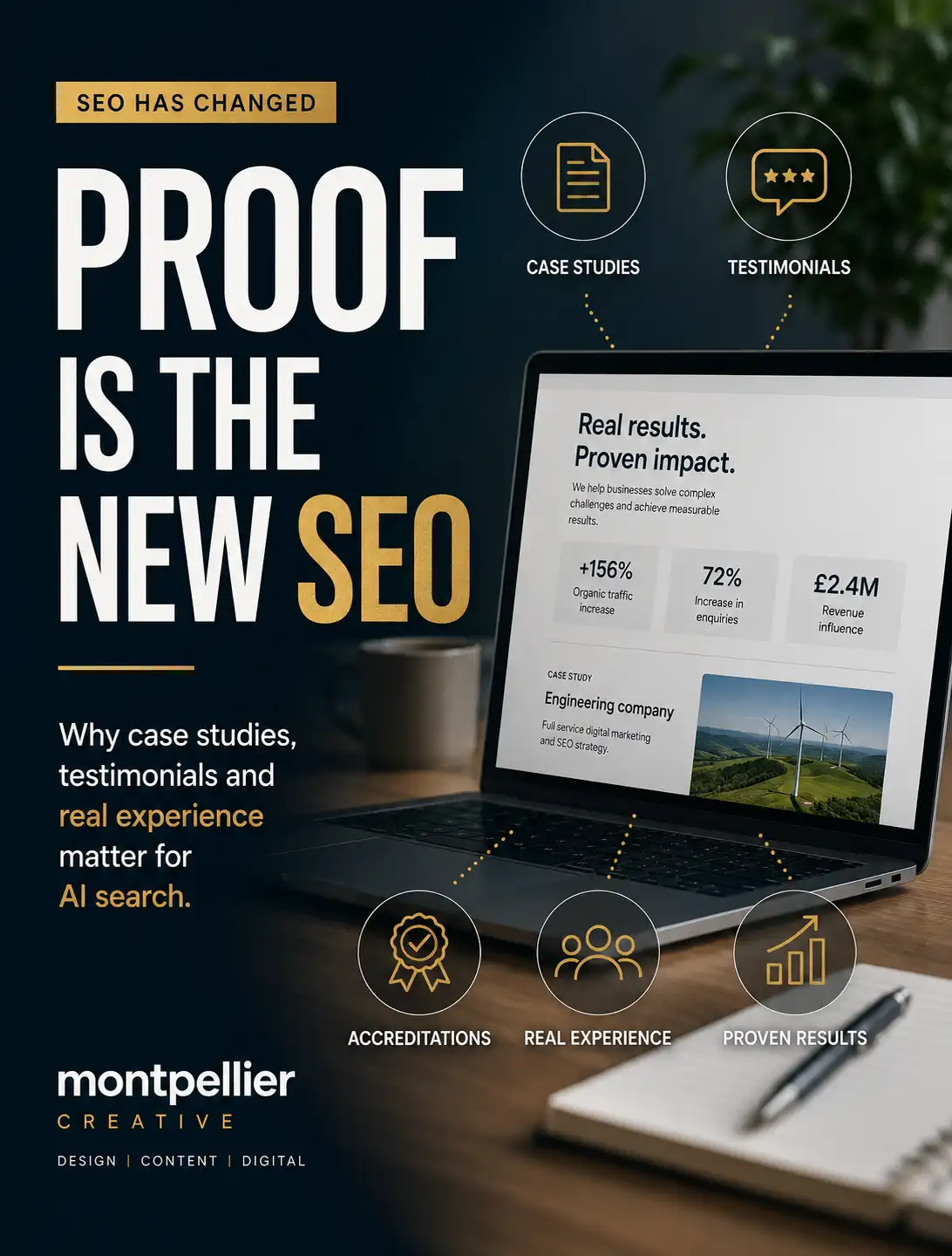
Case studies, testimonials, client examples, accreditations, memberships, awards, team experience and real project outcomes all help build the credibility that modern search increasingly depends on. They help people make decisions. They help search engines understand your authority. And they help AI tools build a clearer picture of whether your business deserves to be included in an answer, summary or recommendation.
In other words, proof is becoming part of visibility.
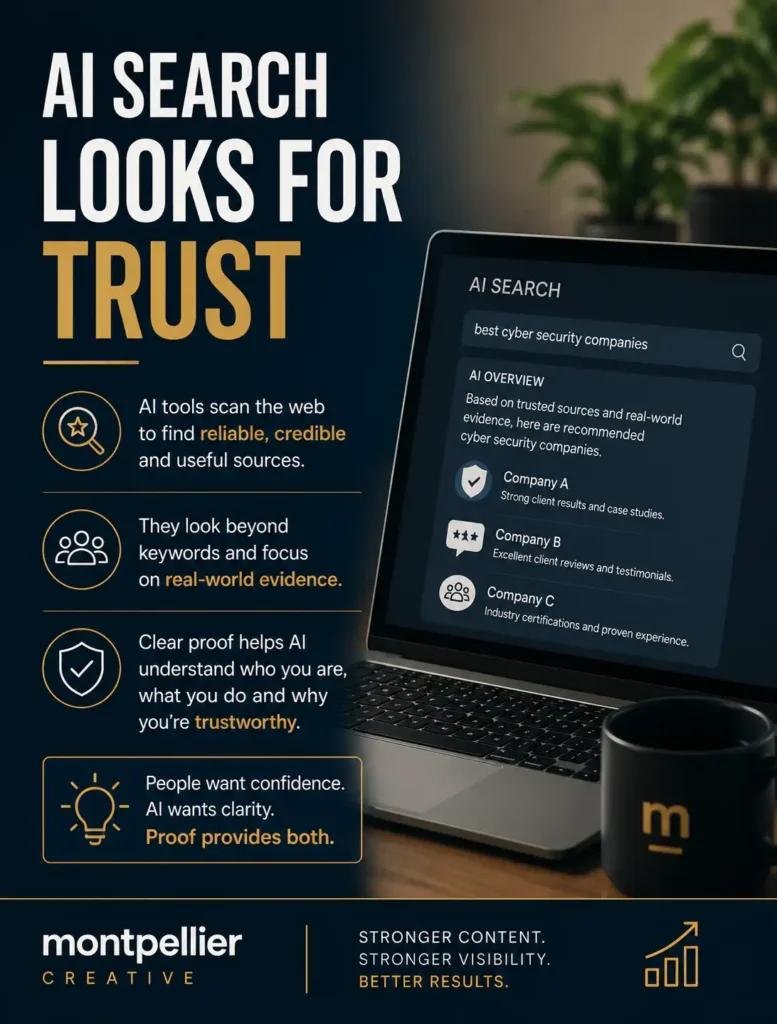
SEO has widened beyond rankings
Traditional SEO is not dead. It still plays an important role in helping businesses become discoverable online.
However, visibility is now more complex than simply ranking in one place for one keyword. A potential customer may encounter your business through Google, Google Maps, an AI-generated summary, a LinkedIn post, a review platform, a directory, a press article or a conversational AI tool.
Each of these discovery routes depends on information, clarity and trust.
A website that is technically sound but vague in its messaging may struggle. A business that has strong experience but does not show it online may be overlooked. A company that claims to be expert but provides little supporting evidence may appear less credible than a competitor with clearer proof.
AI search makes this even more important because AI tools do not simply look for isolated keywords. They work by interpreting context. They assess relationships between topics, services, people, organisations and evidence. They look for signals that help establish whether a source is useful, relevant and trustworthy.
That means businesses need to think carefully about what their website demonstrates, not just what it says.
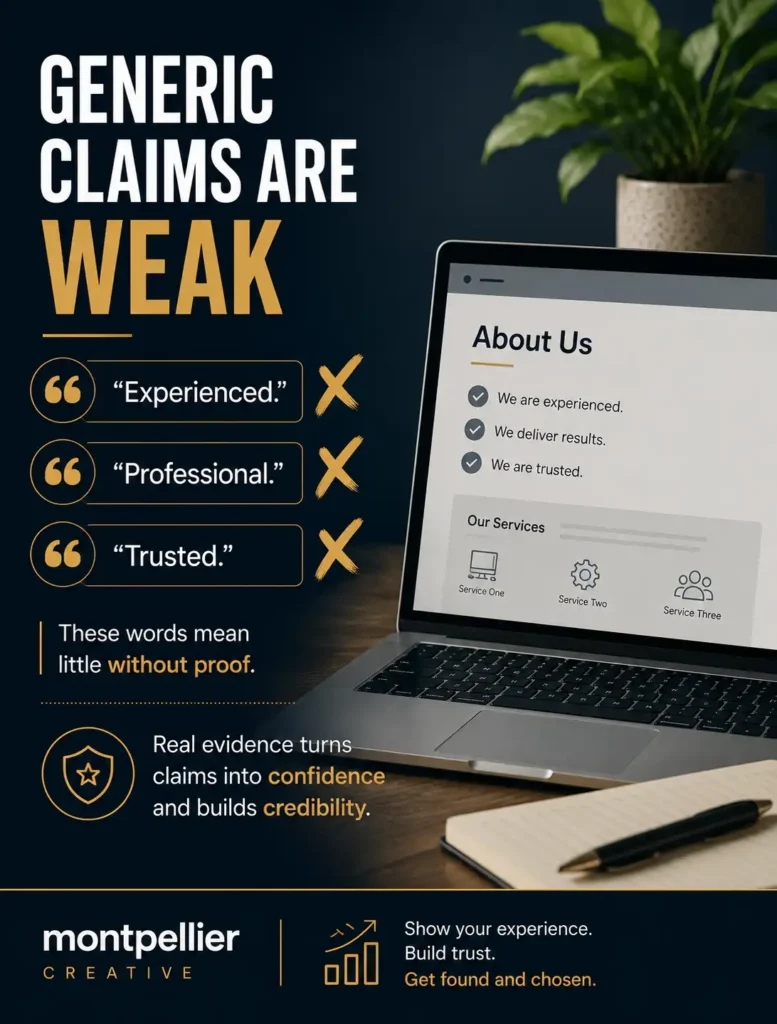
The problem with generic service claims
Many business websites rely too heavily on generic claims.
They say things like:
“We are experienced.”
“We deliver results.”
“We are trusted by our clients.”
“We provide a professional service.”
“We offer tailored solutions.”
None of these statements are necessarily wrong. The problem is that almost every business can say something similar.
Without proof, these claims are weak.
A potential customer reading your website wants to know whether you have solved problems like theirs before. They want to understand who you work with, what kind of projects you deliver, what makes you credible and whether other clients have had a good experience.
AI systems need similar clarity. If your website only makes broad claims, it gives less useful context. If your website includes detailed examples, testimonials, accreditations and project evidence, it becomes easier to understand what your business actually does and why it may be authoritative.
The difference is between saying “we are trusted” and showing why you are trusted.
That distinction matters.
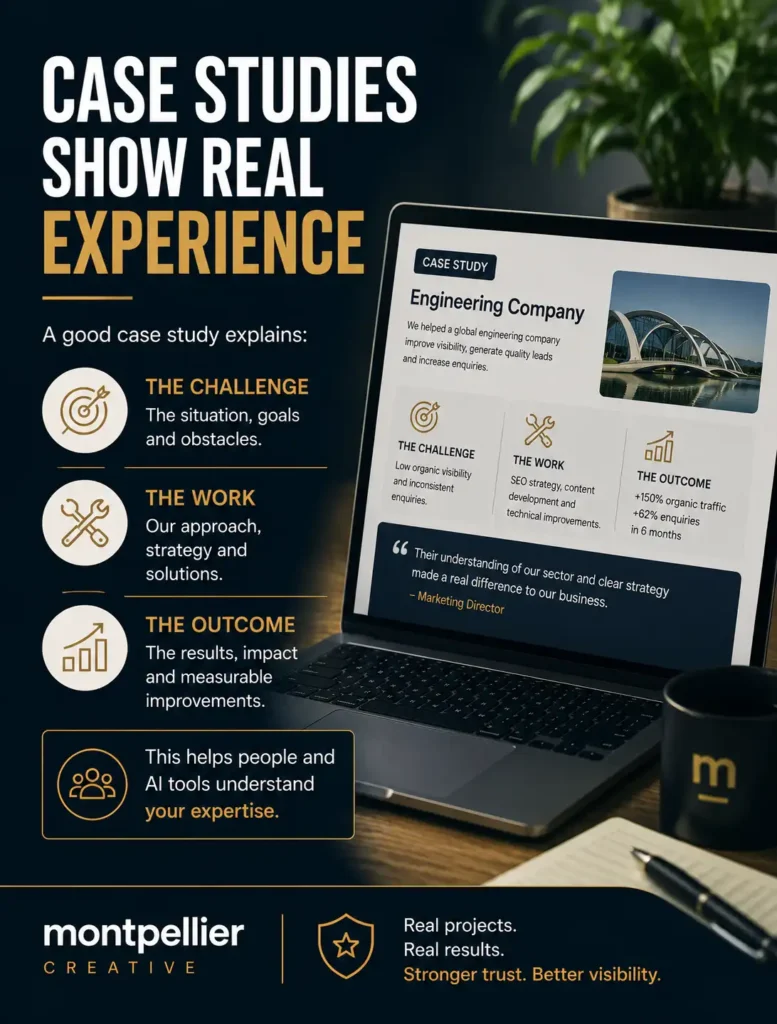
Case studies show real experience
Case studies are one of the most valuable forms of website proof.
A good case study does more than show that a project happened. It explains the situation, the challenge, the thinking, the work carried out and the outcome. It gives potential customers a real example of how your business approaches problems.
For SEO and AI search, case studies are useful because they naturally include detail.
They may include the type of client, the sector, the service provided, the location, the problem being solved, the process followed and the results achieved. This gives search engines and AI tools a richer understanding of your expertise.
For example, a service page might say that you provide website design and SEO.
A case study can show that you redesigned a website for a professional services company, improved the structure of its service pages, created clearer content, added supporting case studies and helped the business become more visible for relevant searches.
That is much stronger than a generic service description.
Case studies also help prospective clients picture themselves working with you. They make your services more tangible. They turn abstract claims into real examples.
If your business has good work that is not being shown on your website, you may be missing one of your strongest visibility assets.
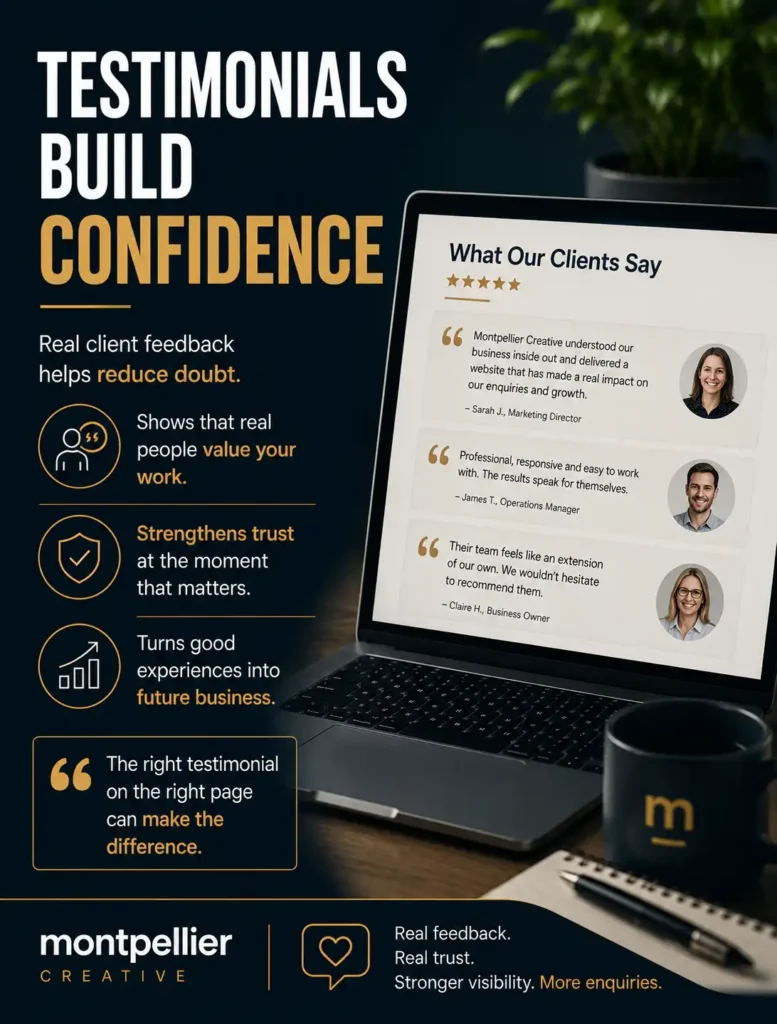
Testimonials build confidence
Testimonials are another important trust signal.
While case studies show what you did, testimonials show how clients felt about the experience. They provide reassurance from a third party. They help reduce uncertainty and build confidence.
A strong testimonial can support the claims you make about your service. It can show that you are reliable, responsive, knowledgeable, creative, organised or effective. It can also highlight specific strengths that may matter to future customers.
Where testimonials are placed is important.
Many websites hide testimonials on a single page that visitors may never see. A better approach is to place relevant testimonials close to the services they support.
For example, a testimonial about a website project should appear on or near your website design page. A testimonial about SEO strategy should support your SEO content. A testimonial from a client in a particular sector may be useful on a sector-specific landing page.
This helps both users and search engines connect the proof to the relevant service.
Testimonials do not need to be long. They need to be specific, credible and easy to find.
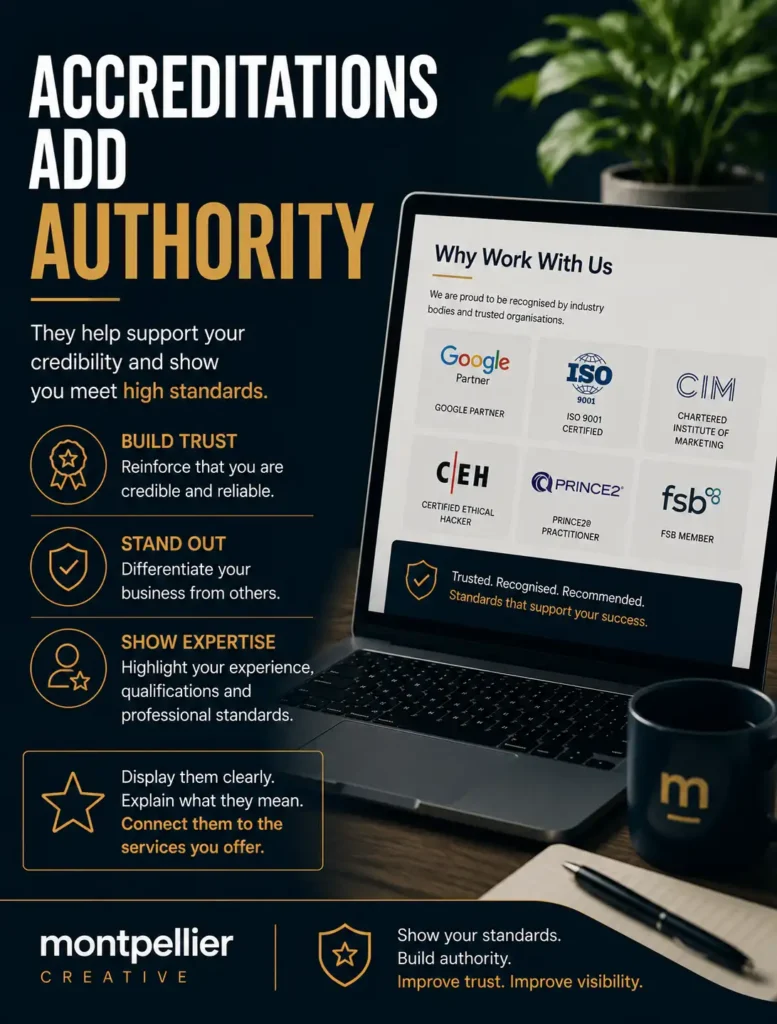
Accreditations, memberships and awards add authority
Formal proof also matters.
Accreditations, memberships, certifications, awards and professional affiliations can all help strengthen credibility. They show that your business has been recognised, approved or associated with relevant organisations.
For some sectors, these signals are especially important. Professional services, technical industries, training providers, defence, healthcare, finance, construction and legal services often rely heavily on credentials and trust.
But many businesses fail to make the most of these signals.
They may place logos in a footer with no explanation. They may mention an award once in a news post and never connect it to a service page. They may have valuable memberships that are not visible at all.
To be useful, these proof points should be clear and contextual.
Explain what the accreditation means. Show why the membership matters. Connect awards to the work they recognise. Use credentials to support your expertise, not simply decorate the website.
AI search depends on context. A logo alone may not say much. A properly explained credential can add authority.
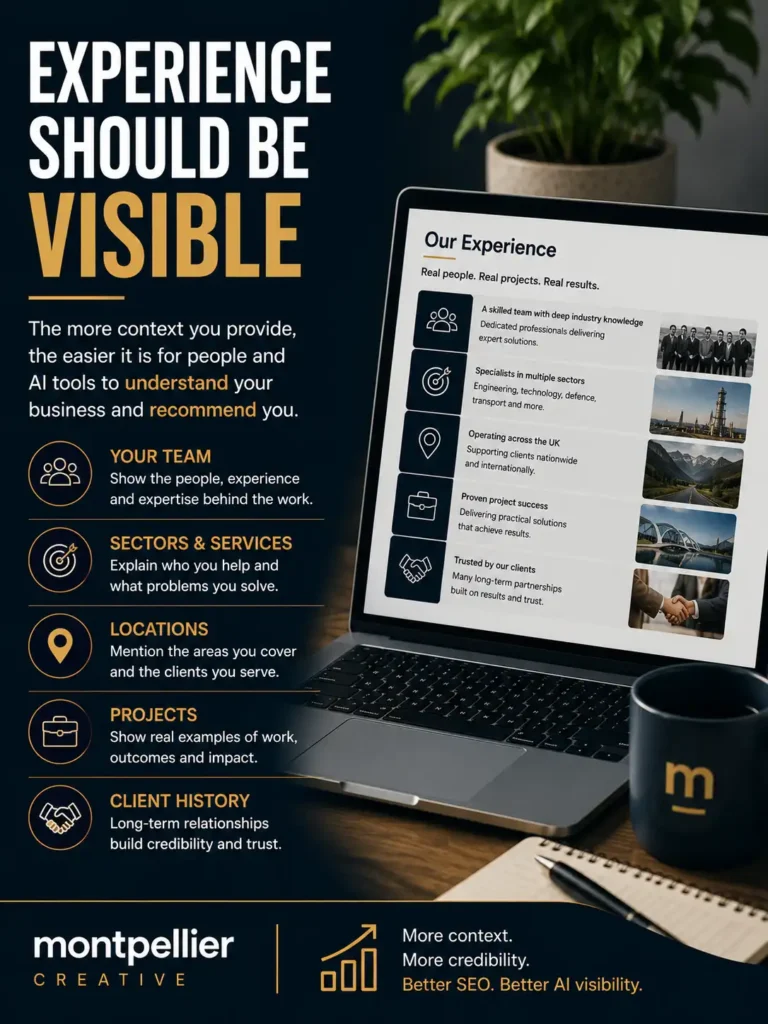
Real experience should be visible
Experience is one of the hardest things to fake and one of the most important things to show.
Your website should make real experience visible.
This can include team profiles, founder stories, years in business, sector knowledge, client relationships, project history, specialist skills and practical understanding.
For many businesses, the people behind the service are a major source of credibility. Yet team pages are often thin, outdated or overly brief. A profile might include a name and job title, but very little about the person’s expertise.
That is a missed opportunity.
A stronger profile can explain what someone does, what they specialise in, what sectors they understand and how they help clients. This does not need to become overly personal. It simply needs to show relevant expertise.
Real experience also includes the language your customers use, the problems you understand and the practical detail you include in your content.
AI search is more likely to understand your authority if your website demonstrates depth, not just surface-level claims.
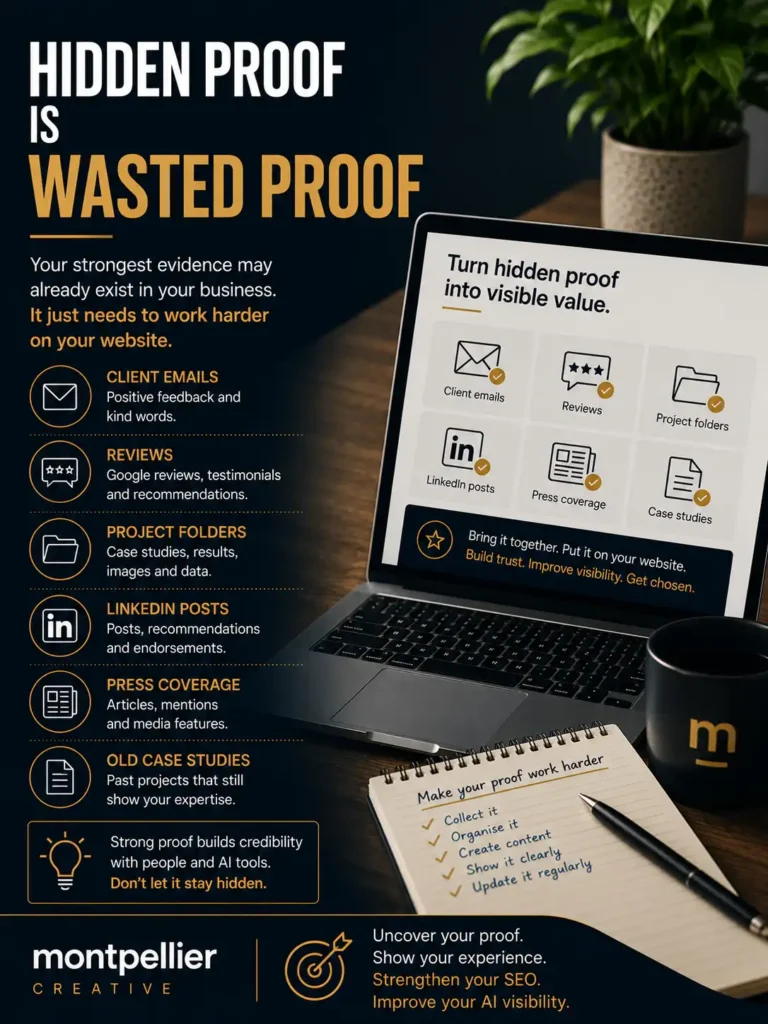
Hidden proof is wasted proof
Most businesses have more proof than they realise.
It may be sitting in old proposals, client emails, Google reviews, LinkedIn recommendations, award submissions, project folders, internal reports, press coverage, photographs, presentations or conversations with the team.
The issue is not always a lack of proof. Often, the issue is that the proof has not been organised and published properly.
If your best examples are hidden in a folder, they cannot support your search visibility. If testimonials are buried in emails, they cannot reassure potential customers. If press articles are not referenced, they may not contribute to your authority. If case studies are missing, your website may look less experienced than your business really is.
Good content strategy involves uncovering this evidence and turning it into useful website content.
That might mean creating case studies, improving service pages, adding testimonial sections, writing articles around common customer questions, updating the about page or building a clearer structure around your expertise.
Proof does not help if no one can see it.
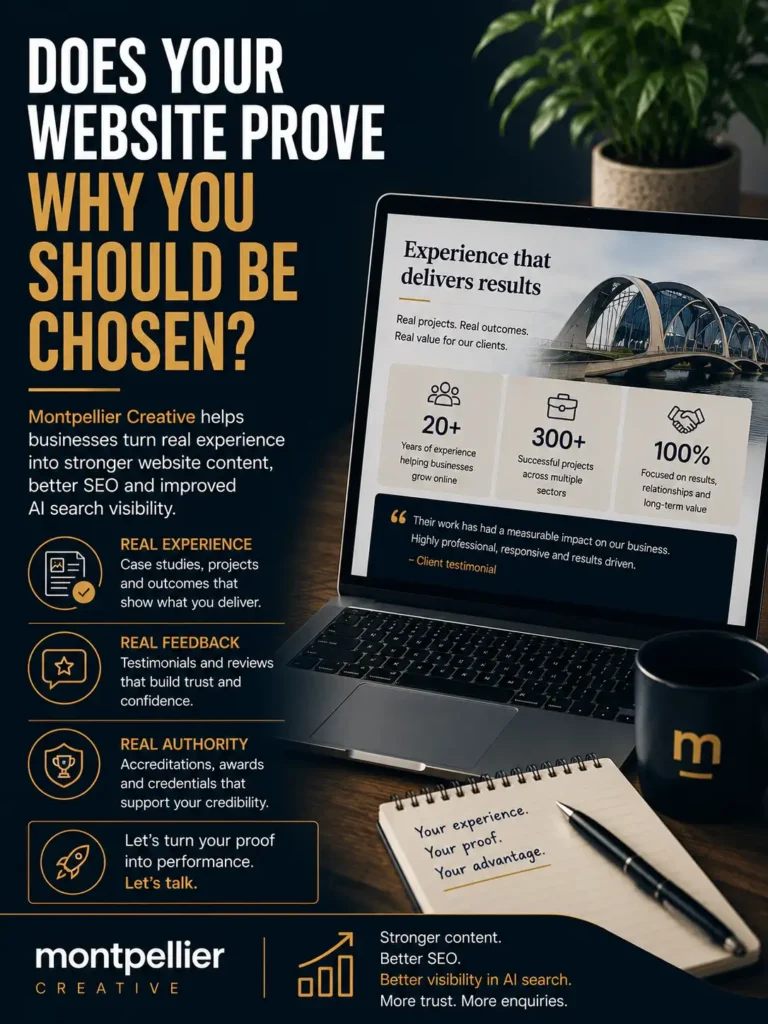
How proof supports AI search
AI search is not only looking for information. It is looking for reliable information.
When an AI tool is asked to recommend a supplier, explain a service or summarise options, it needs to draw on sources that appear credible and relevant. A business website that includes clear services, strong examples, useful explanations and visible proof gives AI systems more to work with.
Proof can help clarify:
who you help, what you do, where your experience sits, what outcomes you support, which sectors you understand, why you are credible, and what makes you different.
This is particularly important for businesses in competitive markets. If several companies offer similar services, the one with clearer evidence may be easier to understand and trust.
AI search visibility is not created by proof alone. Technical SEO, site structure, page speed, schema, content quality and external signals all matter. But proof strengthens the overall picture.
It makes your website more useful, more credible and more convincing.
How to structure proof across your website
Proof should not sit in only one place.
A strong website uses proof throughout the customer journey.
Your homepage should give visitors immediate confidence. Your service pages should include relevant examples and testimonials. Your case study section should show depth across your core services. Your about page should explain who you are and why your experience matters. Your articles should link to related services and examples. Your contact page should reinforce trust at the point of enquiry.
This creates a connected structure.
Instead of isolated claims, your website becomes a network of supporting evidence.
For example, a website design service page might link to a website design case study, include a relevant testimonial, mention awards or accreditations, answer common questions and link to an article about website planning.
That is much stronger than a single page saying, “We design beautiful websites.”
The more connected and specific your proof is, the easier it becomes for both people and AI tools to understand your value.
A simple proof checklist
A useful starting point is to review your website and ask:
- Do your service pages include real examples?
- Do you have case studies for your main services?
- Are your testimonials specific and easy to find?
- Are accreditations, memberships and awards explained properly?
- Do your team profiles show relevant expertise?
- Do your articles link back to services and case studies?
- Is your best work visible?
- Does your website show who you help?
- Does it explain why you are credible?
- Does it make it easy for someone to choose you?
If the answer to many of these questions is no, your website may not be working as hard as it should.
Proof helps you get found and chosen
The future of search will not only reward websites that contain the right keywords.
It will reward websites that are clear, useful, credible and trusted.
That is why proof matters.
Case studies show real experience. Testimonials build confidence. Accreditations support authority. Team profiles demonstrate expertise. Project outcomes show impact. Press coverage and external mentions can add further validation.
Together, these signals help your business become easier to understand, easier to trust and easier to recommend.
At Montpellier Creative, we help businesses build websites and content that do more than look good. We help them explain their services clearly, structure their expertise properly and turn real experience into stronger digital visibility.
Because good SEO is no longer just about being found.
It is about being understood, trusted and chosen.
FAQ: Proof, SEO and AI Search
What does “proof is the new SEO” mean?
“Proof is the new SEO” means that search visibility is no longer only about keywords, rankings and technical optimisation. Businesses also need to show evidence of credibility. Case studies, testimonials, accreditations, awards, team experience and real project outcomes all help demonstrate that a business is trustworthy and experienced.
Why does proof matter for AI search?
Proof matters for AI search because AI tools need clear signals to understand whether a business is credible. If a website only makes broad claims, it may be harder for AI systems to assess its authority. Real examples, testimonials and evidence help AI tools understand what a business does, who it helps and why it may be worth recommending.
Do case studies help with SEO?
Yes, case studies can help with SEO because they add useful, specific and experience-based content to a website. A good case study can include service details, sector context, location references, client challenges, the work completed and the outcome. This gives search engines and AI tools more relevant information to understand your expertise.
How do testimonials support search visibility?
Testimonials support search visibility by strengthening trust and credibility. They show that real clients have valued your work. When testimonials are placed on relevant service pages, they can also help connect proof directly to the services you want to be known for.
What are trust signals in SEO?
Trust signals in SEO are features that help demonstrate credibility. These can include case studies, client testimonials, Google reviews, accreditations, awards, professional memberships, named team profiles, press coverage, project examples and clear contact information.
What proof should a business website include?
A business website should include proof that supports its main services. This may include relevant case studies, testimonials, accreditations, awards, client examples, team experience, project outcomes, press mentions, reviews and examples of previous work. The most useful proof is specific, visible and connected to the right service pages.
Where should testimonials appear on a website?
Testimonials should appear close to the services they support. Rather than hiding all testimonials on one page, it is often better to include relevant testimonials on service pages, landing pages, case studies and contact pages. This helps visitors see proof at the point where they are making a decision.
Are accreditations and awards useful for SEO?
Accreditations and awards can be useful for SEO when they are clearly explained and relevant to the business. They help support authority and trust. Rather than only displaying logos, websites should explain what the accreditation or award means and why it matters to customers.
Why are team profiles important for AI search?
Team profiles help show the real experience behind a business. They can explain who delivers the work, what expertise they have and which sectors or services they understand. This adds credibility and helps both people and AI tools understand the depth of expertise within the company.
How can press coverage help SEO and AI visibility?
Press coverage can help SEO and AI visibility by providing external validation. Articles, interviews and media mentions can show that a business is active, credible and recognised beyond its own website. When combined with strong website content, press coverage can help build authority and trust.
What is hidden proof?
Hidden proof is valuable evidence that exists within a business but is not visible on the website. This might include positive client emails, old project examples, reviews, proposal material, award entries, press mentions or LinkedIn recommendations. Turning hidden proof into website content can improve credibility and search visibility.
How can a business improve proof on its website?
A business can improve proof on its website by reviewing its main services and adding relevant evidence to support them. This could include creating case studies, adding testimonials to service pages, improving team profiles, explaining accreditations, referencing awards and making project examples easier to find.
Does AI search replace traditional SEO?
No. AI search does not replace traditional SEO. It builds on many of the same principles, including clear content, strong structure, technical performance and authority. The difference is that AI search places even more importance on context, credibility and useful answers.
What kind of content is best for AI search visibility?
The best content for AI search visibility is clear, useful, structured and credible. It should explain what your business does, who it helps, what problems it solves and why it can be trusted. FAQs, case studies, service pages, expert articles, testimonials and comparison content can all support AI search visibility.
How does proof help a business get chosen?
Proof helps a business get chosen by reducing doubt. Potential customers are more likely to contact a business when they can see evidence of experience, results and credibility. Search engines and AI tools also benefit from clear proof because it helps them understand why a business may be relevant and trustworthy.