Search is changing, and it is changing quickly.
Online visibility has largely been discussed in terms of Google rankings. Businesses wanted to appear on page one. Marketing teams tracked keyword positions. SEO activity focused heavily on improving rankings, increasing website traffic and encouraging more enquiries from organic search.
Those things still matter. Google has not disappeared, and traditional search engine optimisation remains important. But the way people find, compare and choose businesses is widening.
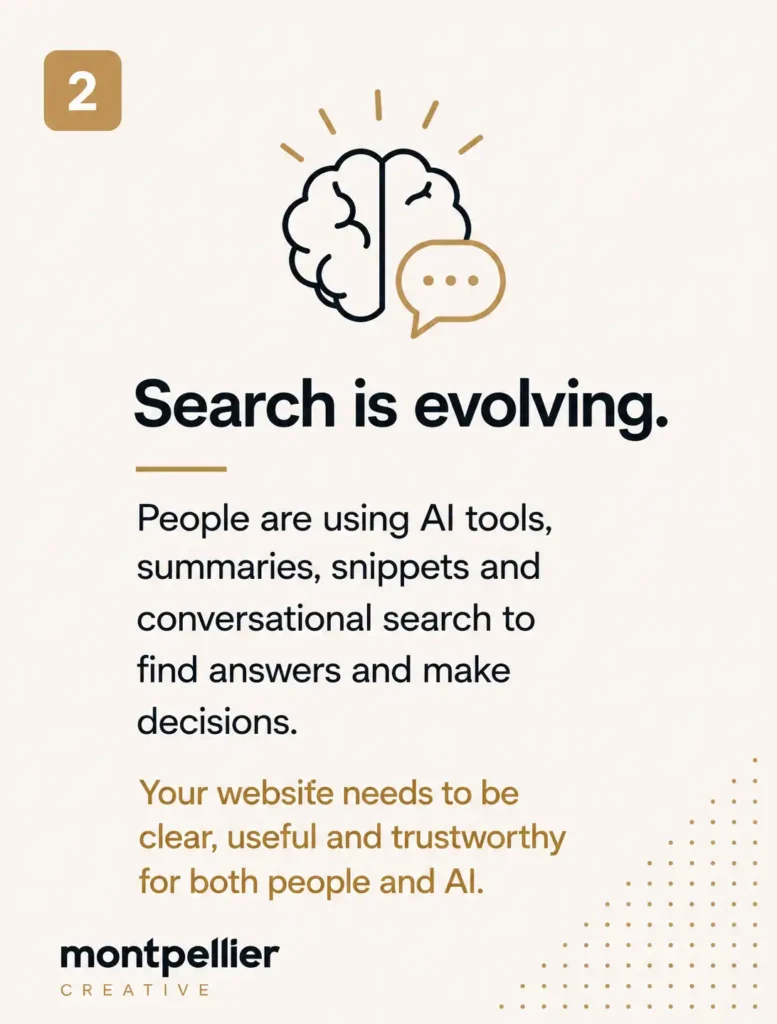
Today, people are no longer relying only on a list of blue links. They are using AI tools, search summaries, snippets, maps, reviews, social platforms and conversational search to get answers faster. They might ask an AI tool to recommend suppliers, compare service providers, explain a problem, summarise options or identify the most credible businesses in a particular sector.
This means your website now has to work harder.
It needs to be clear enough for people to understand. Structured enough for search engines to interpret. Useful enough to answer real questions. And credible enough to be trusted by both humans and AI-driven systems.
So, the question is no longer simply: “Does your website rank?”
The better question is: is your website ready for AI search?
What do we mean by AI search?
AI search refers to the growing use of artificial intelligence within the search and discovery process.
This includes AI-generated summaries in search results, conversational tools such as ChatGPT and Gemini, AI assistants, answer engines and search experiences that provide users with direct responses rather than simply showing a list of websites.
Instead of typing a short keyword into Google, users are increasingly asking more detailed questions.
For example:
“Which marketing agency can help a B2B company improve visibility across Google and AI search?”
“What should I look for in a website design agency?”
“Why is my website not generating enquiries?”
“Which local agency has experience in SEO, content and website strategy?”
These kinds of questions require more than a single keyword match. AI systems look for context, clarity, authority, relevance and trust signals. They need to understand who you are, what you do, who you help and why your business should be considered credible.
That makes your website more important, not less.
Why your website still matters
There is a misconception that AI search reduces the importance of websites. In reality, it makes good websites more valuable.
AI tools need information to draw from. Search engines still need pages to crawl, interpret and evaluate. Potential customers still need somewhere to verify your credibility, explore your services and decide whether to contact you.
Your website is your central source of truth.
It should explain your business clearly, support your expertise and provide the kind of useful information that helps people make informed decisions. If your website is vague, thin or poorly structured, it becomes harder for both people and AI systems to understand why you should be recommended.
A visually attractive website is not enough on its own. Design matters, but design needs to be supported by substance.
A site that looks polished but says very little may still struggle to perform.

Sign 1: It is not immediately clear what you do
One of the most common website problems is unclear positioning.
A visitor lands on the homepage and is met with broad language such as “creative solutions”, “innovative thinking” or “helping businesses grow”. These phrases may sound positive, but they do not always explain what the business actually does.
AI systems face a similar problem. If your website does not clearly describe your services, sectors, audience and expertise, it may not be easy to interpret or recommend.
Your website should make it obvious:
who you are, what you offer, who you help, where you operate, and what makes your approach different.
This does not mean every page needs to be overloaded with text. It means your messaging needs to be specific.
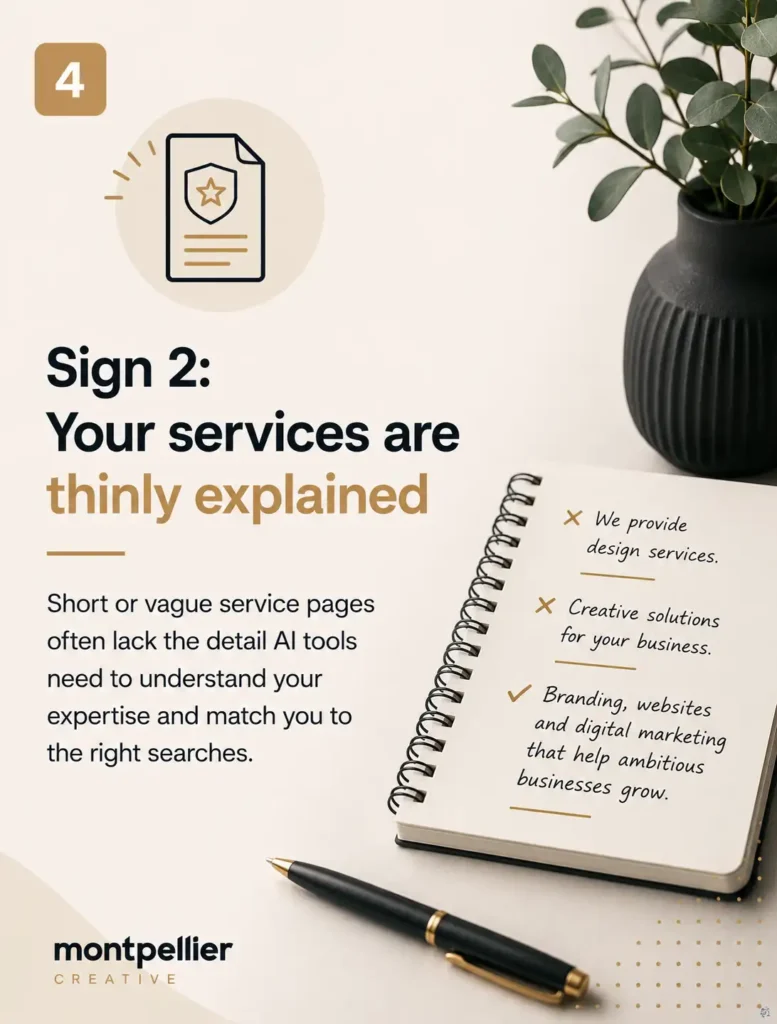
For example, “We provide design services” is vague.
“Branding, websites and digital marketing for ambitious businesses that want to improve visibility and generate better enquiries” is clearer.
Clarity helps people. It also helps search engines and AI tools understand your relevance.
Sign 2: Your service pages are thinly explained
Many businesses have service pages that are too short.
A page might include a heading, a few sentences and a contact button. That may be enough to confirm that the service exists, but it rarely provides enough detail to build confidence or support search visibility.
A strong service page should explain the service properly. It should answer the questions a potential customer is likely to ask before making contact.
For example:
What does the service include?
Who is it for?
What problems does it solve?
What is your process?
What experience do you have?
What results can it support?
What related services should the customer also consider?
AI search favours useful, specific and well-structured information. Thin pages often fail because they do not provide enough context.
If you want your website to be visible for more detailed, conversational searches, your service pages need depth.
Sign 3: Your content is disconnected
Another common issue is disconnected content.
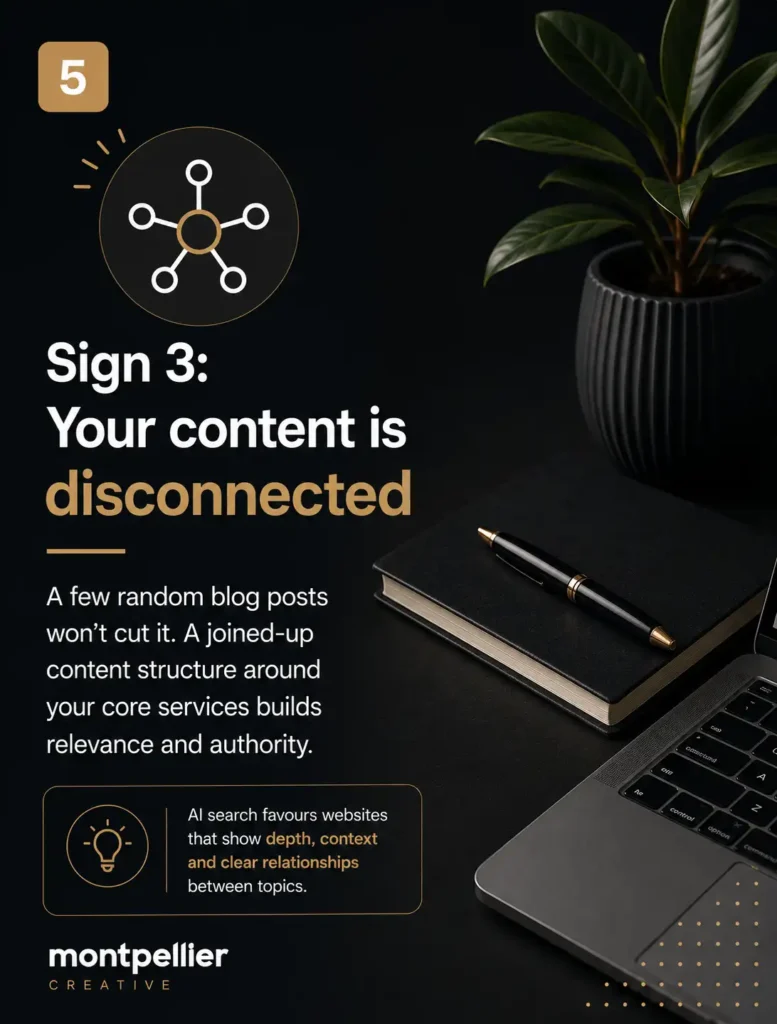
A business may have a handful of blog posts, news updates or articles, but they do not connect properly to the core services. They may cover interesting topics, but they do not build a clear picture of expertise.
AI search and modern SEO both benefit from joined-up content.
This means creating a structure where your main service pages, supporting articles, FAQs, case studies and internal links all work together.
For example, a business that wants to be known for SEO and AI search visibility might need content around:
SEO strategy, AI search, technical SEO, website structure, content planning, case studies, local visibility, digital PR, FAQs and measurement.
Each article should not sit in isolation. It should support a wider topic area and link naturally to relevant service pages.
This creates a stronger signal of authority. It shows that your website has depth, context and clear relationships between subjects.
Sign 4: Your proof is hidden
AI search is not just about what you claim. It is also about the evidence that supports those claims.
Your website should make your proof easy to find.
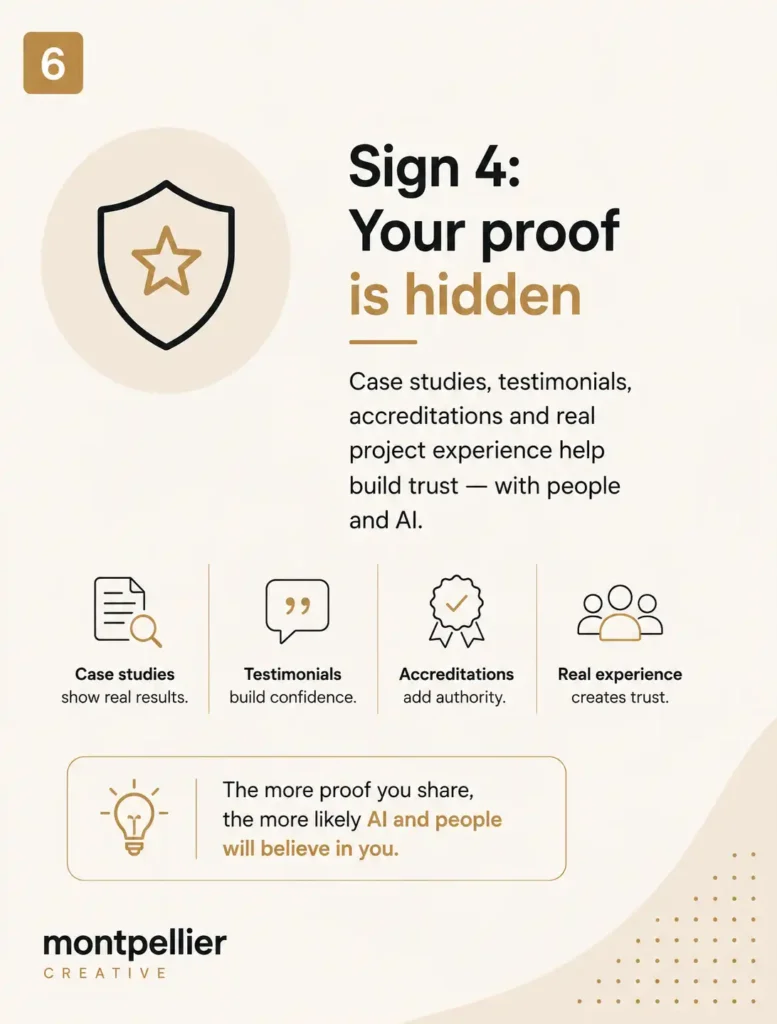
This can include case studies, testimonials, client examples, accreditations, memberships, awards, named team members, sector experience, project results and long-standing client relationships.
For service-based businesses, proof is particularly important. Potential customers want reassurance that you understand their needs and can deliver. AI systems also look for credibility cues that help establish trust.
If your best work is hidden away, missing from your website or only mentioned briefly, you may be weakening your own visibility.
Good proof does not need to be boastful. It needs to be clear, relevant and accessible.
A case study showing the challenge, approach and outcome can be far more valuable than a generic statement saying “we deliver results”.
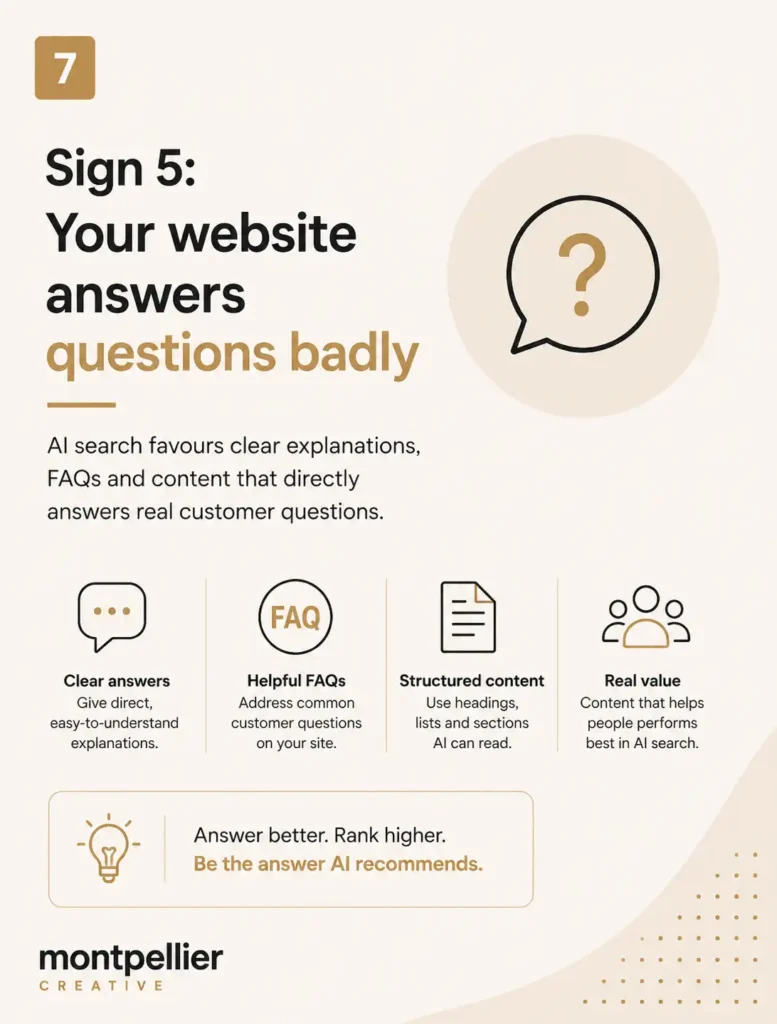
Sign 5: Your website does not answer customer questions
People use search because they have questions.
AI search makes this even more important because users increasingly ask complete, conversational questions rather than short keyword phrases.
Your website should answer those questions directly.
This might include FAQs, advice articles, glossary content, comparison pages, process explanations and practical guides. The aim is not to create content for the sake of it. The aim is to provide genuinely useful answers that help customers understand their options.
For example, a potential customer might ask:
How much does a new website cost?
How long does an SEO strategy take to work?
What is the difference between SEO and AI search optimisation?
Do I need separate pages for each service?
How do case studies help online visibility?
What should a website audit include?
If your website answers these questions clearly, it becomes more useful. It also becomes easier for search engines and AI tools to associate your business with relevant expertise.
Why structure matters
AI search rewards clarity, but clarity is not only about writing style. It is also about structure.
A well-structured website helps users move from broad information to specific detail. It helps search engines understand which pages are most important. It helps AI systems identify relationships between your services, content and expertise.
Good structure includes clear navigation, descriptive headings, logical service categories, useful internal links, concise summaries and content that is broken into understandable sections.
Structured data and schema can also help by giving search engines more context about your content, organisation, FAQs, articles and services.
The easier your website is to understand, the more likely it is to perform well across different forms of search.
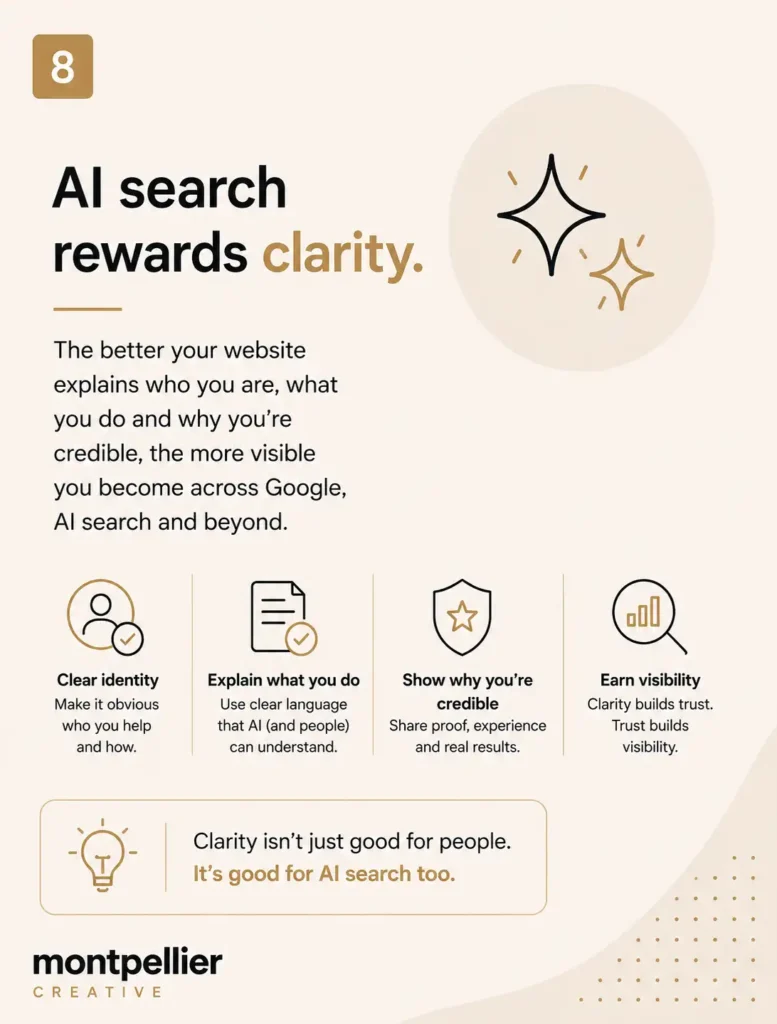
AI search rewards clarity
The businesses that benefit from AI search are likely to be those that communicate clearly.
That does not mean producing generic AI-written content. In fact, generic content is unlikely to be enough. Businesses need content that reflects real expertise, real services and real customer understanding.
Your website should show:
clear positioning, detailed services, joined-up content, visible proof, helpful answers and a strong sense of credibility.
The better your website explains who you are, what you do and why you are credible, the more visible you can become across Google, AI search and wider digital discovery.
Is your website ready?
AI search is not something businesses should ignore. It is already influencing how people discover information, compare suppliers and make decisions.
But preparing for AI search does not mean abandoning good SEO principles. It means building on them.
The fundamentals still matter: clear content, technical health, useful pages, strong authority, relevant links, good user experience and trustworthy information.
What has changed is the standard.
Websites now need to be more useful, more specific and more credible. They need to serve human visitors while also being structured in a way that search engines and AI tools can understand.
At Montpellier Creative, we help businesses build websites and content that work harder — not just for traditional search rankings, but for the wider search landscape that is now emerging.
If your website has thin service pages, vague messaging, hidden proof points or disconnected content, now is the time to improve it.
Because the future of search will not only reward businesses that are visible.
It will reward businesses that are clear, useful and trusted.
Is your website ready for the next stage of search?