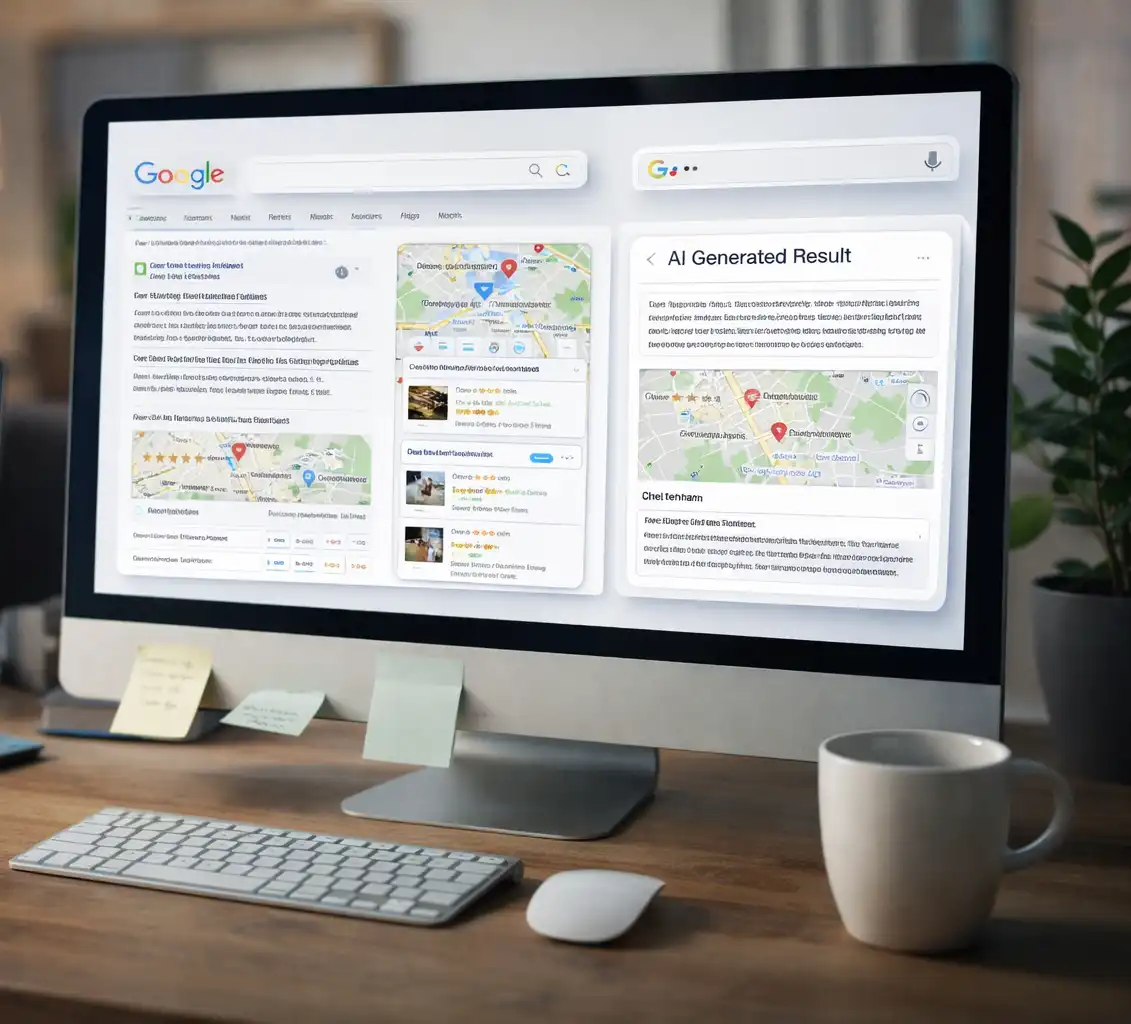
SEO strategy has changed more in the last three years than it did in the decade before. While rankings still matter, they no longer tell the full story. Visibility today is shaped by a far broader ecosystem — one that includes traditional search results, AI-generated answers, local packs and contextual recommendations.
In 2026, an effective SEO strategy is not about chasing positions for their own sake. It is about ensuring your business is understood, trusted and surfaced at the moments people make decisions.
This article explores how SEO strategy now works in practice, why older approaches fall short, and what businesses should focus on if they want sustainable visibility across Google, AI search and local results.
Why rankings alone are no longer enough
For many organisations, SEO reporting still revolves around keyword positions. While rankings remain useful indicators, they are increasingly unreliable as a proxy for real performance.
A business can rank on page one and see little commercial return, while another may generate consistent enquiries from a mix of featured snippets, local listings and AI summaries without holding a dominant organic position.
This shift reflects how search engines now operate. Their primary objective is no longer to rank pages, but to resolve intent. That means prioritising clarity, authority and usefulness over mechanical optimisation.
A modern SEO strategy starts by redefining success. The goal is not simply to rank, but to be visible where and when decisions are made.
Why rankings alone are no longer enough
For many organisations, SEO reporting still revolves around keyword positions. While rankings remain useful indicators, they are increasingly unreliable as a proxy for real performance.
A business can rank on page one and see little commercial return, while another may generate consistent enquiries from a mix of featured snippets, local listings and AI summaries without holding a dominant organic position.
This shift reflects how search engines now operate. Their primary objective is no longer to rank pages, but to resolve intent. That means prioritising clarity, authority and usefulness over mechanical optimisation.
A modern SEO strategy starts by redefining success. The goal is not simply to rank, but to be visible where and when decisions are made.
Understanding the modern search ecosystem
Search is no longer a single results page. Today, visibility may come from multiple surfaces, including:
- Organic listings
- Local map packs
- Featured snippets and “People also ask” results
- Knowledge panels and brand entities
- AI-generated summaries and conversational responses
Each of these surfaces is influenced by different signals, but they share a common foundation. Search engines and AI systems need to clearly understand:
- What a business does
- How credible it is in its field
- How consistently it communicates its expertise
SEO strategy in 2026 must therefore consider how a brand is interpreted, not just how individual pages perform.
From keywords to topics: a strategic shift
Keywords still matter, but they are no longer the starting point. Search engines are now far better at understanding intent and context, recognising that related ideas belong together even when phrased differently.
Someone searching for “SEO strategy” may also be seeking guidance on competitor analysis, technical constraints, content quality or measurement — whether or not they use those exact terms.
This is why modern SEO strategy focuses on:
- Topical authority, not isolated keywords
- Depth of explanation, not surface-level answers
- Clear relationships between ideas, not disconnected blog posts
Well-structured topic clusters consistently outperform standalone pages. They demonstrate understanding rather than optimisation, which is increasingly how trust is assessed.
Competitor analysis as a strategic too
Competitor analysis remains a core part of SEO strategy, but its role has changed. Rather than being a shortcut to keyword lists or link targets, it is now best used as a diagnostic exercise.
Effective competitor analysis looks beyond rankings to understand:
- How competitors structure their content
- Which topics they cover thoroughly — and which they avoid
- How they demonstrate experience and authority
- Where their content lacks clarity or depth
This allows businesses to identify opportunities to explain things better, not just copy what already exists. In 2026, differentiation comes from clarity, not imitation.
Technical SEO: essential but no longer a differentiator
Technical SEO is still fundamental. Pages must load quickly, function well on mobile devices, and be accessible to search engines. Structured data and clean site architecture remain important.
However, technical competence is now assumed.
Search engines expect these basics to be in place. Failing them will hold a site back, but excelling at them rarely delivers a competitive advantage on its own.
As a result, SEO strategy should treat technical SEO as infrastructure: ongoing, essential and quietly effective. The real gains now come from how well a site explains its subject matter and supports user understanding.
Content that demonstrates experience, not just knowledge
One of the most significant changes in recent years has been the emphasis on experience. Search engines are increasingly capable of distinguishing between content that simply repeats accepted ideas and content that reflects applied understanding.
In practice, this means prioritising content that:
- Explains why decisions matter, not just what to do
- Acknowledges trade-offs rather than offering absolutes
- Recognises context, constraints and real-world complexity
This kind of content may feel less formulaic than traditional SEO writing, but it performs better because it aligns with how people actually search, read and decide.
Internal linking as a strategic signal
Internal linking has evolved from a technical consideration into a strategic signal.
When content is logically connected, it helps search engines and AI systems understand:
- Which pages are foundational
- How topics relate to one another
- Where authority should be concentrated
A strong SEO strategy deliberately uses internal links to reinforce topical structure. Core “pillar” pages link out to supporting articles, while those articles link back with clear context and intent.
This not only improves crawl efficiency but strengthens semantic relevance across the site..
Measuring what really matters in 2026
If rankings are no longer the sole indicator of success, measurement must evolve.
A modern SEO strategy considers a broader range of signals, including:
- Visibility across different result types
- Engagement with informational content
- Assisted conversions from organic traffic
- Brand mentions and implied authority
Small ranking movements may matter less than consistent visibility across AI summaries, local results or decision-stage queries. The objective is momentum across the ecosystem, not perfection in a single metric.
SEO strategy as an ongoing system=
Perhaps the most important shift is how SEO strategy is framed internally.
In 2026, successful SEO is not a campaign with a fixed endpoint. It is an ongoing system that evolves alongside the business, the market and the technology shaping search behaviour.
That system typically includes:
- Continuous content development
- Regular competitor reassessment
- Ongoing technical maintenance
- Periodic refinement based on performance data
When SEO is treated this way, it becomes resilient. Algorithm updates become less disruptive, and visibility compounds over time rather than arriving in short-lived spikes.
Final thoughts: visibility is built through clarity
SEO strategy in 2026 is less about gaming algorithms and more about earning trust — from users, search engines and the AI systems increasingly mediating discovery.
Businesses that succeed are those that:
- Communicate their expertise clearly
- Structure their knowledge coherently
- Demonstrate experience honestly
- Connect ideas meaningfully
Rankings still matter, but they are no longer the destination. They are a by-product of visibility built the right way.
In the next article in this series, we will look in more detail at competitor analysis — not as a shortcut to rankings, but as a framework for building genuine authority in competitive search landscapes.
Measuring success differently
As AI-led search answers more queries directly, traditional traffic metrics can become misleading.
A mature SEO strategy looks beyond raw sessions and considers:
- brand search growth
- assisted conversions
- inclusion as a referenced source
- quality of engagement
- local visibility across relevant queries
Visibility is no longer a single metric — it is an outcome of alignment.
Where to start in practice
For organisations reviewing their SEO strategy in 2026, the most productive starting point is often a simple question:
Is it immediately clear what we do, who we help and why we are credible — both to users and to machines?
If the answer is uncertain, the opportunity is rarely tactical. It is structural.
Small improvements to clarity, structure and intent often unlock disproportionate gains in visibility across all three search environments.
Final thoughts
SEO strategy in 2026 is less about chasing algorithms and more about earning selection.
The businesses that perform best are not those producing the most content or following the latest trick, but those that:
- communicate clearly
- structure information intelligently
- align design, content and technical foundations
- reinforce trust consistently
In an environment where search is increasingly mediated by AI, that clarity is not optional. It is the strategy.
If you would like to explore SEO and Ai in more detail, listen to our Podcast
https://www.montpellier-creative.com/seo-meets-ai-montcast-on-the-future-of-digital-visibility/