In July last year, I wrote about the rise of conversational search and the growing influence of AI on SEO. Six months on, those ideas are no longer theoretical.
As we move into 2026, AI-led search experiences — summaries, conversational modes and assistant-style results — are already shaping how people discover brands. For businesses investing in WordPress websites, technical SEO and local visibility, the implications are practical rather than abstract.
This isn’t about chasing the next shiny tool. It’s about understanding how search now evaluates clarity, structure and trust — and building websites that perform accordingly.
AI hasn’t replaced SEO — it’s raised the bar
One misconception I still hear is that AI-generated answers “replace” websites. In reality, they rely on them.
AI-led search systems don’t invent expertise. They retrieve, assess and summarise existing content. That means poorly structured, ambiguous or technically fragile websites are less likely to be surfaced — even if the underlying knowledge is sound.
For WordPress sites in particular, this has sharpened the divide between:
- sites that look good
- and sites that are designed to be understood by both users and machines
Why WordPress builds matter more than ever
WordPress remains the dominant CMS for small and mid-sized businesses, but AI-driven search has exposed a long-standing issue: many WordPress sites are visually polished yet structurally weak.
In 2026, effective WordPress builds share a few common traits:
- Clear page purpose Each page answers a specific question or fulfils a specific intent. Vague “overview” pages are harder for AI systems to interpret and cite.
- Predictable structure Logical heading hierarchies, restrained use of page builders, and consistent templates make content easier to parse.
- Performance discipline Page speed, Core Web Vitals and mobile stability still matter — not as ranking tricks, but as basic signals of quality and usability.
A WordPress site that is technically tidy, semantically clear and content-led is far more likely to be surfaced as a reliable source in AI-assisted results.
Technical SEO is no longer invisible work
Technical SEO used to be something clients rarely noticed unless it went wrong. That’s changed.
AI-led search depends heavily on clean retrieval:
- accurate indexation
- sensible internal linking
- unambiguous canonicalisation
- consistent signals about what a page is and isn’t
When these foundations are weak, content can be skipped entirely — not because it’s poor, but because it’s confusing to extract.
In practice, this means technical SEO in 2026 is less about chasing edge cases and more about:
- removing friction
- reducing ambiguity
- making intent obvious
It’s also why technical SEO works best when paired closely with design and content, rather than treated as a bolt-on audit.
Design and SEO are now inseparable
AI hasn’t made design less important — it’s made purposeful design essential.
Design choices influence:
- how quickly a page communicates its intent
- whether key information is surfaced early
- how easily a system can distinguish primary content from decoration
Over-designed pages with buried answers, heavy animation or vague headings may still impress visually, but they underperform in an environment that rewards clarity.
This is where design + SEO packages genuinely earn their keep. When structure, content and visual hierarchy are planned together, the result is a site that works for humans and search systems — including AI-driven ones.
Local SEO in an AI-first world
Local search has also evolved.
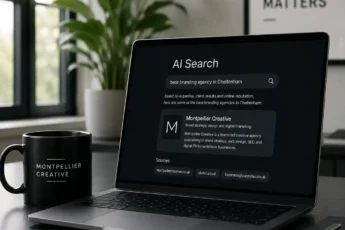
AI summaries increasingly blend:
- business profiles
- on-site content
- reviews
- location context
For local businesses, this means your website needs to do more than repeat your Google Business Profile.
Strong local SEO in 2026 focuses on:
- location-specific service pages that explain how you work locally
- clear signals about service areas and relevance
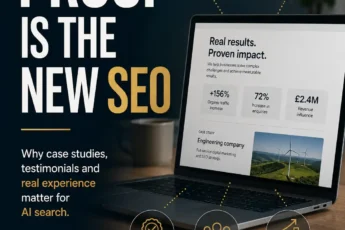
- genuine proof of local experience (case studies, testimonials, imagery)
AI systems are looking for confidence and consistency across signals — not keyword stuffing.
What hasn’t changed (and probably won’t)
Despite the noise, some fundamentals remain stubbornly reliable:
- Clear answers beat clever wording
- Evidence beats assertion
- Structure beats volume
- Consistency beats hacks
AI has simply made these principles more visible.
A practical focus for the year ahead
If you’re planning work on your website or SEO in 2026, the most effective starting point is often a simple one:
Does our site clearly explain who we help, what we do, and why we’re credible — within the first few seconds of landing on a page?
If the answer is “not really”, that’s where the opportunity lies.
Final thought
SEO in 2026 isn’t about chasing algorithms. It’s about building digital assets that are easy to understand, easy to trust and easy to surface — whether the reader is human or machine.
That tends to reward businesses that invest properly in their WordPress builds, treat technical SEO as part of the craft, and stop separating design from performance.
If that’s the direction you’re already heading in, you’re probably closer than you think.